How much do you know about China's Tang Dynasty?
The Tang Dynasty (618-907), one of the most important dynasties in Chinese history, is also recognized as one of the most powerful periods in China. In May 618, Li Yuan “李渊”proclaimed himself emperor and named the state Tang. Li Yuan was the Emperor Gaozu Tang“唐高祖”. After Li Shimin “李世民”ascended to the throne, the yuan was changed
Zhenguan, through a series of reforms to the Tang Dynasty into the peak, known as the "zhenguan governance."“贞观之治” Later, during the Reign of Emperor Gaozong, Wu Zetian “武则天”gradually came to power. In 690, wu Zetian proclaimed herself emperor, changed the name of the state from Tang to Zhou, and called herself the Holy Emperor. Empress Wu“武” also became the only woman in Chinese history to call herself an emperor, ruling for more than 50 years. After the death of Wu Zetian, the political situation was in chaos, and then Emperor Xuanzong ascended the throne. At this time, the political integrity was relatively clear, the economy developed rapidly, and the Tang Dynasty entered its heyday, which is known as the "Kaiyuan Heyday"“开元盛世” in history. This period is considered to be the second great prosperity in Chinese history after the period of Emperor Wuzetian of Han Dynasty.
Emperor Xuanzong indulged in pleasure in his later period and never asked for state affairs. Later, An Lushan took advantage of political corruption, military emptiness and Shi Siming to launch a rebellion, known as "an and Shi Chaos". Emperor Xuanzong fled to Chengdu, and The crown prince Li Heng proclaimed himself emperor in Lingwu, as Emperor Suzong of Tang. An Lushan called himself Emperor of Dayan, and his reign name was Shengwu“圣武”. It took eight years before the rebellion was put down. Tang Dynasty vitality was greatly injured, from the boom to decline.
In the later period of the Tang Dynasty, there was a situation of Niu li “牛李党争”party strife and eunuchs interfering in the government, which made the government even darker and was finally destroyed by the vassals.
Due to the developed economy, the Culture of the Tang Dynasty was in the leading position in the world at that time, and the cultural exchanges with many countries in the world were very frequent. Korea and Japan sent many students to chang 'an to study. The friendly exchanges between the Tang Dynasty and The Arab region brought emeralds, pepper and Islam into China. Forty percent of the murals and sculptures in the Dunhuang Mogao Grottoes“敦煌莫高窟” are from the Tang Dynasty.
Literature of the Tang Dynasty -- scholarship
The literary achievement of the Tang Dynasty was most developed in poetry. The Complete Poems of the Tang Dynasty compiled by the Qing Dynasty included more than 2,200 poets.Forty-eight thousand nine hundred poems, and that's not all. The poets of the early Tang Dynasty were most famous for the "four heroes of the early Tang Dynasty" (Wang Bo, Yang Jiong, Lu Zhaolin and Wang Luobin,“王勃,杨炯,卢照邻,骆宾王”). Poets in the prosperous Tang dynasty can be divided into the pastoral school represented by Wang Wei and Meng Haoran and the frontier School represented by Cen Shen and Wang Changling. Among them, li Bai and Du Fu are the most famous. Li Bai's poems, elegant and free, full of romantic color. Du Fu's poems are more realistic. The most outstanding poet of the middle Tang dynasty was Bai Juyi, whose poems were easy to understand. In addition, yuan Zhen, Han Yu, Liu Zongyuan, Liu Yuxi, Li He and so on. Li Shangyin and Du Mu were the most outstanding poets in the late Tang Dynasty, who were called "Xiao Li du". Although there were still outstanding poets in the later Song, Ming and Qing dynasties, their overall level was not as good as those in the Tang Dynasty, and Tang poetry became the unsurmountable peak of ancient Chinese poetry.
In prose, since the six Dynasties, parallel prose has prevailed in the literary world, which emphasizes rhyme, duality and classics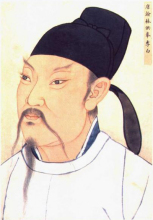
Therefore, the rhetoric is luxuriant, mainly four - word sentences and six - word sentences. It was very popular in the early Tang Dynasty and was most famous for the four heroes of the early Tang Dynasty. However, this style appeared rigid in form and empty in content in the Tang Dynasty. Therefore, in the Reign of Tianbao, ancient Chinese prose gradually rose. The movement nominally aims to restore the prose of the pre-Qin and Han Dynasties, but in fact it aims to make the prose more content, that is, "to carry the tao in the prose". Han Yu is the first of the eight great men of the Tang and Song Dynasties. His prose is magnificent and profound, which is known as "the decline of the eight generations of literature". However, after the death of Han Liu, the ancient prose movement in the Tang Dynasty gradually declined, and parallel prose resurfaced in the late Tang Dynasty. Legend is a classical Chinese novel form that appeared in the Sui Dynasty and flourished in the Tang Dynasty. Famous legends include The Biography of Liu Yi, The Biography of Ying Ying, the Biography of Nan Ke Taishou, The Memoir of Pillow Zhong and the Biography of Long Hate. Some legends have been adapted into plays and vernacular novels in later generations. The tang dynasty also played an important role in the history of Chinese literature. The so-called bianwen originally refers to the buddhist monks preach Buddhism and sing buddhist scriptures. At first it was limited to Buddhist texts, but later other stories began to be told by people other than monks. Bianwen has a great influence on legends and later rap literature
Art and costumes
Art
As a result of absorbing the characteristics of the Xiyu and religious color, the Art of the Tang dynasty and the capital of the previous dynasties
Bunian Tu by Tang Dynasty painter Yan Liben
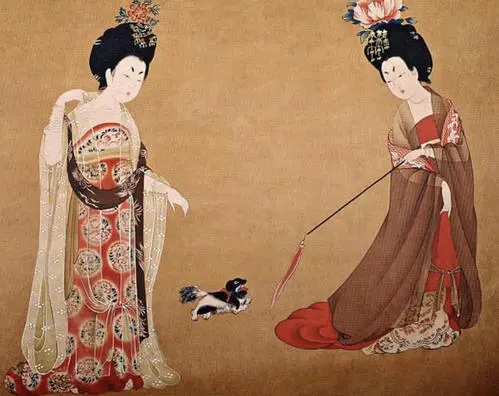
Very different. Yan Liben and Yan Lide in the early Tang Dynasty were good at painting figures. Wu Daozi is called "painting saint", he is good at figures, landscape, and absorbed the techniques of western region painting school, the picture is full of three-dimensional sense, there is "Wu dai when the wind" said. Zhang Xuan and Zhoufang mainly painted pictures of maids, and their famous works include "dao Lian", "Guo Lady on a spring outing of Guo" and "Ladies with Zanhua", which further developed figure painting.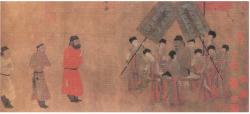
During the Wei, Jin and Southern and Northern Dynasties, landscape landscapes were mostly used to set off the theme of figures, but since the Sui and Tang Dynasties, landscape landscapes became the theme, and landscape painting, an important branch, emerged. There were two factions, the North and the South. Poet Wang Wei is good at ink landscape painting, is a representative of the Southern school, Su Shi commented that "there is painting in poetry, there is poetry in painting". Li Sixun, a painter of the Northern school, made good use of green to paint mountains and waters. Cao Ba and Han Gan were good at painting horses, Han Hwang was good at painting cows, Xue Ji was good at painting cranes, and Bian Luan was good at painting peacocks.
The mural industry of the Tang Dynasty was particularly developed. Mogao Grottoes and tomb murals are masterpieces handed down from generation to generation. The art of sculpture in the Tang Dynasty was equally outstanding. Dunhuang, Longmen, Maijishan and Bingling Temple grottoes all entered their heyday during the Tang Dynasty.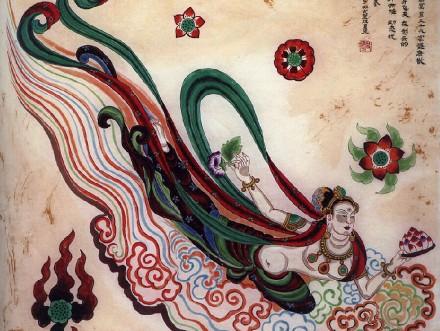
The Lushena Giant Buddha in Longmen Grottoes and the Leshan Giant Buddha in Sichuan province are both amazing. The six horses of Zhaoling tomb and the three-color terracotta figures are very beautiful. Among them, sculptor Yang Huizhi is known as the plastic saint. During the Tang Dynasty, many calligraphers came out. Ouyang Xun and Yu Shinan were both famous calligrapher in early Tang Dynasty. Ouyang xun's regular script is very neat, and Jiu Cheng Gong Li Quan Ming is his famous work. Yu Shinan's regular script font is soft and round. His representative works are Confucius Temple Tablet, Princess Runan epitaph, Copying the Preface of the Orchid Pavilion, etc. Yan Zhenqing and Liu Gongquan were famous calligraphers in the middle and late Tang Dynasty. Yan Zhenqing's regular script with thick pen, containing muscles and bones, jinjian free and easy, his representative works are "Many pagoda monument", "Yan's heirloom temple monument"
Tang’s Costume
The decorative art of tang Dynasty is characterized by its gorgeous and beautiful style. For example, as can be seen from the dunhuang caisson pattern, the hanging curtain has been transformed into wreaths, and luxuriant flowers have grown on the rolled grass. The leaves of c. chinensis become more diverse and thicker. Most of these flowers are dense double petals that are not fully unfurled, with each petal full of juice and swelling and unwinding.
Generation of curly grass pattern in Dunhuang caisson patterns, are bright and gorgeous colors
The tang dynasty costumes patterns of flowers and plants from the Tang Dynasty were common on brocade and damask fabrics, bronze mirrors and porcelain. The relief on the side of tang dynasty steles with floral patterns of rolled grass shows the healthy style of Tang dynasty patterns.
In the flower pattern, lotus is further enriched, treasure phase flowers began to be popular. Peony as a famous flower in Luoyang“洛阳”, in the scope of decorative arts has also become the most attention after the pattern.
What cooperate with flower pattern photograph is a few birds, butterfly and so on. Especially the small flowers and small birds formed a small scene, very poetic. Pairs of birds such as mandarin ducks are also common.
In the animal patterns of the Tang Dynasty, there are some dragons and phoeniths, which are very vivid.
The most obvious characteristic of tang dynasty decorative pattern in style is its realistic style, the organization has a certain regularity, image processing, but not a lot of deformation. The decorative art in tang Dynasty is another great change since the end of the Warring States period.Why are these hanfu looser?
What was the society like in tang Dynasty?
In the Tang Dynasty, although the power of the family was reduced, it was still not an equal society. "
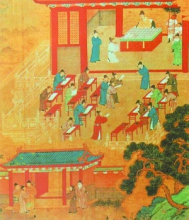
The Law of Tang also stipulates that people are divided into two categories: "good" and "cheap". Untouchables can only marry untouchables. The landlord who killed Buqu would be punished for one year at most, and buqu who killed the landlord would be beheaded. Although the imperial examination system was implemented, the children of their families had better cultural accomplishment because of their superior living conditions. It was not very difficult for them to enter the official career no matter whether they took the imperial examination or not. There were not a few prime ministers of the Tang Dynasty who were from the family. The selection of jinshi in the Tang Dynasty also had some meaning of public evaluation. The measures to prevent fraud were not strict. Often, candidates asked for help from the examiners and boasted about themselves, but at that time, people did not regard it as fraud. Du Fu, who was talented, failed the exam twice.
In the Tang Dynasty, the county surname of Shandong in the north maintained a high social status. Taizong once asked Gao Shilian to compile the clan annals in the hope of rating the family according to their political status. The results were not very successful, but with the implementation of the imperial examination system, it was difficult for big families to maintain their family status. The niuli party strife was for the abolition of the imperial examination system, but it could not prevent the rise of the common people, plus the advent of printing, convenient circulation of books, private lectures are common, family can not monopolize knowledge. The years of turmoil in the middle Tang Dynasty and the Five Dynasties caused unprecedented damage to the inheritance of the northern gentry, which had faded away in the Northern Song Dynasty. After that, Chinese leaders were no longer inherited from their families, but from the imperial examination system through "three generations of wealth".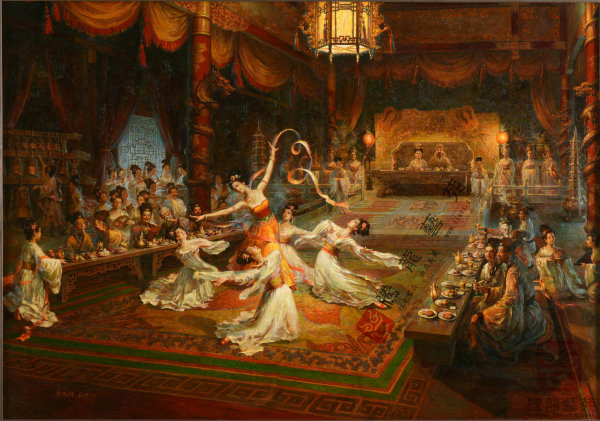
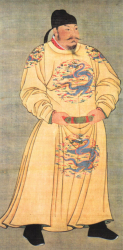
The Tang Dynasty was the time when "Hu Feng" prevailed. The so-called "hufeng", especially popular in tang dynasty, the social from all walks of life but not the han nationality society reveals the original, which mainly include the nomads from the north and Xiyu from the customs, there are five hu period of sixteen countries south of the nomads legacy of social custom, the outcome of combined action of various factors, formed in the tang dynasty hu feng's current situation. Such as "hu le", "Hu fu", "Hu food" and so on are extremely popular in Chang 'an city. The foreign costume culture of the Western regions had a great influence on the costume of the Tang Dynasty. In the Sui and Tang dynasties, there was a double-track system of Hu and Han in northern China. Xianbei Hu was the daily uniform, and traditional Han (Tang) was used for solemn sacrificial occasions. The status of women in the Tang Dynasty was higher, which was also reflected in their costumes. Noble and court women are more half-bare-breasted loose skirt. The skirt is tied high at the waist. The singer's dress is dyed bright and gorgeous, and the aristocrat's is dyed rich and elegant. According to the collar style, it is divided into round collar, lapel collar, square collar, diagonal collar, straight collar and chicken heart collar. Emperor Wen of the Sui Dynasty initiated the practice of wearing yellow dragon robes. During the reign of Emperor Wu de of the Tang Dynasty, subjects were not allowed to wear yellow unauthorised, and yellow robes became the exclusive clothing of the royal family. The Tang Dynasty is rich, fat and rich for the aesthetic orientation.
Statues and pictures of beautiful women vary in craft and age from girls and young women, but most of them have faces like the full moon, full cheeks and beautiful eyebrows, and rounded waists. Their costumes are bare and bold. Even the "handmaid holding the cup", which is now acclaimed as the first beauty in ancient China, has a distinctive and graceful gesture, and its basic characteristics are still "plump, rich and beautiful, and enthusiastic posture".
It is clearly reflected in both art works and real life that people in the Tang Dynasty advocated "rich and beautiful, and enthusiastic posture". This is different from the han Dynasty and most other periods in ancient times, which appreciated the reserved and introverted aesthetic view of fair ladies, and formed the "alternative" aesthetic vision in the Tang Dynasty. However, this kind "alternative" with the beauty glamour of the abundant and fat that goes against the tradition, not only what do not inferior to the tradition is slender and bony feeling, and have vitality and upward vigor more. In fact, a little analysis will find that the tang people's "alternative" aesthetic is the inevitable characteristics of the heyday era.
First of all, the Tang Dynasty was prosperous and had plenty of food and clothing. Just as the poet Du Fu wrote in his poem, People are well fed, well clothed and healthy and plump. Secondly, the Tang Dynasty was open and inclusive, with strong national strength and developed civilization, which made the Tang people full of confidence and became a highly open country. According to incomplete statistics, tang had contacts with more than 130 countries at that time. With the influence and integration of different cultures, the Tang people are not confined to tradition, broaden their horizon and warmly put their attitude. Third, the lineage of the ruler also determined that the Tang people were more close to the strong body. The maternal grandfather of Li Yuan, the first emperor of the Tang Dynasty, was a great noble of Xianbei, that is to say, at least half of the blood lines of the Imperial family of Li and Tang were xianbei blood lines, and the nomadic life of Xianbei people created and needed a strong and fierce body.
Main features
1.Tang Dynasty culture has three basic characteristics. First, the cultural system is huge and complete, high degree of development; Second, the Tang Dynasty culture is very open; Third, Tang culture has obvious characteristics of being close to the people, focusing on the real world, and not sticking to the ancient system.
The cultural system of the Tang Dynasty includes literature, religion and philosophy, history, art, astronomy and calendar, geography, mathematics, medicine, hundreds of arts and crafts, and basically covers most components of social science and natural science in the world at that time. Such a huge and complete cultural system was the only one in the world at that time. Tang culture was advanced in the world at that time. At that time, Chang 'an“长安”, the capital of the Tang Dynasty and the cultural center of Asia, was coveted by all countries. Japan, Korea, Vietnam and other countries connected by a strip of water or mountains and rivers constantly introduced Tang culture into their own countries.
2.The openness of Tang culture is manifested in two directions, one is the inherent characteristics of Tang culture, the other is the attitude of tang government towards culture.
Tang culture with han culture as the main body, Han culture experienced thousands of years of development, to the early Tang dynasty has been nearly mature stage. In the mature stage, culture has the confidence to maintain its own characteristics and the ability to absorb and digest the contents of other cultures, so it has the mind to accommodate others. Partly because of this, Buddhism, Islam, Zoroastrian, Manichaeism, Nestorianism and other foreign religions were able to enter China one by one. The Buddhism culture of Tianzhu, which had a great influence on China, was finally assimilated and sinicized by the Chinese culture. Confucianism, an important part of Han culture, teaches that "three people are walking together, there must be my teacher". As an ideological form, Confucian culture values "harmony" and has considerable tolerance, which is also an internal reason for the openness of Tang culture. Buddhist culture is also an important part of Tang culture, and the openness of Tang culture is also influenced by Buddhist culture. Buddhism believes that all kinds are not divided and everything is empty, and advocates compassion and universal sentient beings. This universal concept is also an internal reason for the openness of Tang culture. At the beginning of the Tang Dynasty, it was politically and militarily strong. It pursued the policy of "China is safe and the four barbarians are under control" and implemented an open policy. Li Shimin, the enlightened emperor of the early Tang Dynasty, attached importance to cultural exchanges, leaving behind a tradition of openness for the reign of the Tang Dynasty in 289 years. The Tang Government repeatedly sent people to the Western Regions and Tianzhu for cultural exchanges, treated foreign envoys and businessmen who entered China with courtesy, and respected the cultural and religious traditions of foreign residents in China. The Tang Government also set up a special agency in charge of foreign cultural exchanges. This enlightened policy of the Tang government is an important reason for the openness of tang culture.
3.The mature Tang culture got rid of the shackles of form and developed towards the direction of freedom and close to the people and the real world.
For example, when religious culture is mature in theory, it often pays more attention to approaching the people and grasping the people in a way that is easy for the laypeople to accept than metaphysical abstract discussion. The mature Chinese culture in the Tang Dynasty showed such characteristics.
In the literary aspect, Li Bai used his hand to dissolve the elegant and detached content of Taoist thought into the free and uninhibited form of ancient poetry to publicize himself and the joys and sorrows of his time. His poems are highly contagious and emotionally closer to the people than his predecessors. Han Yu initiated the ancient Chinese writing movement, which advocated the ancient Chinese writing close to the spoken language, mainly for the purpose of promoting the Confucianism, and unconsciously found a tool for the Tang society to get rid of the cultural and ideological bondage of the previous dynasties and freely express its new thoughts and opinions. At that time also appeared the legendary novel this kind of civic literature genre, this is also a literature at that time to the common people close to a performance.
In the aspect of philosophy and religion, the new trend of saying the sutra in empty words and preaching in words appeared in Confucianism, and the southern Zen School of Buddhism, which destroyed The Buddha and the ancestor, that is, the mind is the Buddha, all of these are the manifestation of breaking through the previous theories and valuing personal subjective opinions and experiences. At that time, "scholasticized" Buddhist sects such as The Dha-sang-sect died out after only a few biota, while "secularized" Buddhist sects such as the Southern Zen Sect continued to develop strongly. In the Door of Zen sect in tang Dynasty, there appeared poetry monks such as Jiao Ran, Ling Che, Dao Biao, guan Xiu, Qi Ji, Ke Peng, high art monks such as Huai Su, guan xiu, Shan Ben, tea wine monks such as demon master, Ke Peng, Fa Chang, etc. These monks and secular celebrities went back, they secularized the "pure land" in Buddhism, and at the same time, to a certain extent, "pure land" transformed the secular society at that time, that is to say, they poeticized the life of the people in the Tang Dynasty to a certain extent. Buddhism in the propaganda also began to use the vulgar language which is very close to the people.
In the scope of history, scholars such as Liu Zhiji, Du You and so on attach great importance to personnel, pay attention to the solution of practical problems. Many representatives of geography and other academic fields have a similar spirit of
In terms of medicine, medical scientists in the Tang Dynasty represented by Sun Simiao could get rid of the bondage of previous theories and pay attention to cubic treatment according to specific conditions
The folk customs of the Tang Dynasty also appeared more lively. Among the people, singing and dancing were popular, people lived a freer life, and women had a higher social status than in the later Song and Ming dynasties. It can be seen from the tang Dynasty sculpture that tang culture has the characteristic of "humanization". In the statues of Fengxian Temple in Longmen Grottos, the main Statue of The Buddha Is like an emperor, the two bodhisattvas are like concubines, Kaya and Ananda are like civil ministers, and vajra and Shenwang are like military generals. Sculptors in the Tang Dynasty often modeled bodhisattvas on the images of women, and all other gods modeled themselves on figures in real life. Different from the Buddha statues in wei and Jin dynasties, this kind of Buddhist statue lacks "popularity", has stiff appearance and rigid program. On the whole, the Tang people were very confident about their time, and they were more concerned about this time than that.
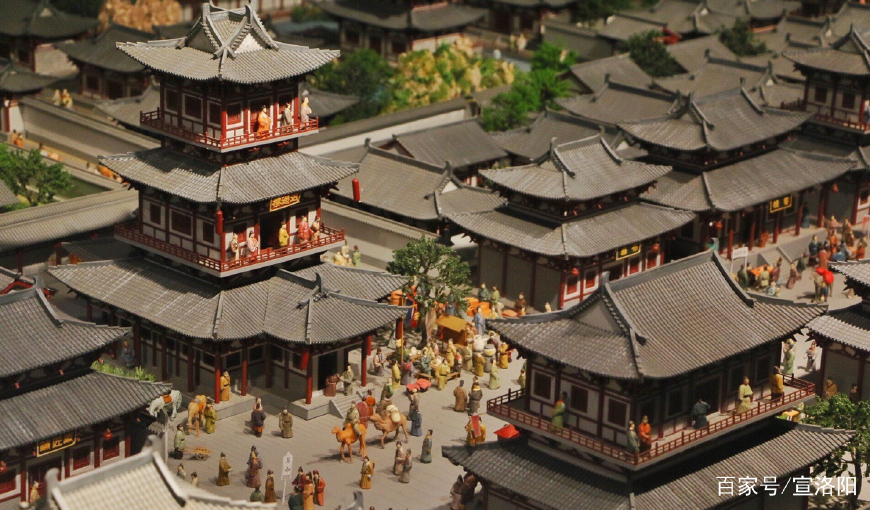
What influence did Tang culture have on the world?
The prosperous economy and culture of the Tang Dynasty and the convenient transportation and management system provided convenience for international communication. It is accessible by land. Sea routes open up more. There are three routes to Japan. And opened up from Guangzhou, Vietnam sea to Southeast Asia, West Asia and Egypt and East Africa sea traffic. Therefore, Tang enjoyed a high reputation in the world at that time and was the center of economic and cultural exchanges among countries in the world.
At this time, Chinese culture and foreign culture rapidly merged, and foreigners and foreigners influenced the Tang society, as well as clothes, food and clothing, fashion. At the beginning of the Tang Dynasty, the social atmosphere was still conservative. Then learn hu people, wearing a hat, wearing a lapel cardigan Hu clothing, to the tang dynasty or dress half sleeve skirt, topless appearance, no cover. Ladies make up to pursue the fashion, such as hair style imitation of ethnic minorities, there are black man bun, zhuan bun; Face decoration is tubo makeup, Huigur makeup and so on. As for the food on the table, it was also varied. During the Kaiyuan period, the royal food was "all for hu".
During the Period of Kaiyuan and Tianbao, a large number of foreigners and the surrounding ethnic minorities filled Chang 'an and lived together with the Han People for a long time. For a time, the social atmosphere even appeared the signs of "hu hua", which caused the concern of the world. But instead of banning it, the Tang Dynasty actively absorbed the essence of foreign cultures, constantly enriched its own nutrition, and melted the customs into Chinese civilization, creating a more colorful and prosperous Tang culture.
1.korean peninsula
Shilla was most influenced by tang culture. As many as 100 students studied in China, and some of them became officials in the Tang Dynasty. Therefore, Shilla imitated tang's political system and established administrative organizations from the central to the local level. The imperial examinations were dominated by the ancient Chinese books Zuo Zhuan and Li Ji, which showed the influence of Tang culture. The poems of bai Juyi, a poet of the Tang Dynasty, were even more popular in Silla. There was no written language in Joseon. In tang Dynasty, Chinese characters were used as notes to create Joseon vocabulary, and Silla characters were actually converted from Chinese characters. In addition, the Silla calendar and laws are modeled after the Tang Dynasty calendar. The popular Buddhist schools of the Tang Dynasty, such as the Tiantai Sect, the Dharma Sang-sect, and the Zen Sect, were also popular in Korea. The Silla also used Chinese medical books such as The Bencao Jing and Su Wen as teaching materials and introduced Chinese medicine to Korea.
2.Japan
Through the continuous exchanges between China and Japan, Japan has been deeply influenced by China in politics, economy, military affairs, culture, production technology and even living style. Among them, the most influential was Japan's "great reform" in 646. This reform modeled the system of the Sui and Tang dynasties, which reformed the official system from the central to the local governments. It also modeled the imperial examination system of the Sui and Tang Dynasties, in which officials were selected by passing examinations. Referring to the laws of sui and Tang Dynasties, the Law of Dabao was formulated.
At the beginning of the 8th century, when Japan moved its capital to Pingchengkyo (now Nara), the construction scale of the capital was completely modeled after That of Chang 'an. Even the width and arrangement of the streets were almost the same. There were also names such as "Zhuque Street", "Dongshi" and "West City". In the late 8th century, Japan moved its capital to Pingan Capital (now Kyoto), which was still modeled after Chang 'an.
Before the 8th century, Japanese used Kanji as a tool for expressing and writing. On the basis of the Japanese people's use of the phonetic and ideographic characters of Chinese characters, the international student Yoshibei Masabe and the learned monk Kogai created the Japanese kana alphabet -- Katakana and Heikana, which greatly promoted the development of Japanese culture. At the same time, Japanese vocabulary and grammar are also influenced by Chinese.
The living habits and festival customs of The Japanese were also influenced by the Tang Dynasty.
3.Vietnam
The sui and Tang dynasties carried out the same cultural and educational system and talent selection policy in Annam as in the mainland. Tang Lu Shuyi, a representative of one of the world's five law systems, "Chinese Law System", has a great influence on the legal history of Vietnam. The influence of Confucianism as the representative of Han culture is a main line of cultural exchange between China and Vietnam, but The influence of Chinese Buddhism on Vietnam is also considerable.
At the beginning of the ninth century, the Chinese monk Wordless Zen master went south to Jiaozhou and created the "Wordless Tong Zen School", which played an important role in the development of Zen Buddhism in Vietnam. In the 10th century, after the independence of Vietnam, most of the rules and regulations of the dynasties were based on the Tang Dynasty, and the imperial examination system was based on the content of poetry, fu, classics and meanings. Vietnamese Jiang Gongfu should try to be an official tang, the official to admonish the doctor, with the book door under the ping chapter, one of the tang Dynasty name. Jiang Gongfu han culture is very deep, his fu "Bai Yun Zhao Chun Hai Fu" and "to the outspoken extreme remonstration" were included in the "Complete Tang".
After the Tang Dynasty, Chinese culture continued to exert influence on Vietnam. At the turn of the 13th and 14th century, The Vietnamese created the national character "Ci-nan" by means of shape, sound, understanding and disguise, according to Chinese characters. But Chinese characters have always played an important role in Vietnamese culture. Even in modern times, many Vietnamese are still familiar with Chinese. In the 17th century, Latin replaced Ci nan as the prevailing language in Vietnam, but the influence of Chinese culture on Vietnam did not stop.
4.Xiyu
What do the Xiyu mean?:
In ancient Chinese documents, it mainly refers to many countries and regions west of Yumen Pass and Yang Pass in China. Under the influence of the Silk Road, western Regions especially refers to most of Xinjiang and some parts of Central Asia of today, which are under the jurisdiction of administrative agencies arranged by the Chinese government in Han and Tang dynasties. Located in the center of Eurasia, it is an important part of the Silk Road.
Persian and Arab merchants also entered the Tang Dynasty by land or by sea during this period. They were famous for trading in jewelry and making huge profits. Through them, food such as spinach, jujube, hu cake, and three leer pulp, as well as acrobatics such as swallowing knives and spitting fire, entered the tang society. The handicraft technology of paper making and weaving was also spread to the Western world, which brought great changes to the society there.
With the arrival of the Hu people from the Western Regions, Zoroastrianism, Nestorianism and Manichaeism spread into the hinterland of the Tang Dynasty. These foreign religions, especially Indian Buddhism, which had already spread in China, penetrated into every aspect of the Tang dynasty society and had a great influence on philosophy, literature, linguistics, architecture, art, etc.
Silk in the West: In the Tang Dynasty, silk was the main export, and the silk trade between China and the West was flourishing. China's silk weaving technology, such as the foot spinning wheel and printing and dyeing technology, was introduced to the West through the western countries such as The Rest of China, and Indian craftsmen in the Tang Dynasty also taught textile technology to central Asia and West Asia, thus the silk industry in Europe developed.
In the tenth year of Tianbao of Emperor Xuanzong of the Tang Dynasty, the Tang Army was defeated by Da Food and a large number of soldiers were captured. Many of them were paper makers. The technology of paper making was then introduced to Da Food and then spread to Europe, playing an important role in the spread of European and world culture.
Academic knowledge is transmitted to the west:In the Tang Dynasty, The Chinese characters and scriptures were imported into Gaochang, and the criminal law and marriage customs of Gaochang mimicked the Tang style. Other countries in the Western Regions, such as Shule and Yanqi, also learned The Chinese characters and customs and wore Chinese clothes. Along the Silk Road, archaeologists also found fragments of bamboo slips from the Annals of the Historian and the Analects of Confucius, which showed that Chinese book culture had spread to Tang dynasty, and that the western regions, as well as Tubo and Nanzhao, sent their emperors to study in Chang 'an, making it the center of learning in the Tang Dynasty.
Technology transfer to the west:Chinese paintings and textiles spread to the West and prevailed in Arabia. The Indians also copied the Chinese in cast iron and well sinking. The silk, tea, paper and medicinal materials of the Tang Dynasty were also exported to the Western Regions, Tianzhu, Persia, dawei and other countries, and were sold to the West through Persia.
Establishment of foreign trade agency:With the rapid development of sino-foreign trade, the Tang government set up a "ship Division" in guangzhou, an important port, and set up "trade supervision" in wuwei, Zhangye and other land routes to manage foreign trade. Chang 'an also attracted many students from the Western Regions to study in China, making chang 'an a center of sino-foreign economic and cultural exchanges.
If reproduced, please indicate the original from the HanfuClub


评论
发表评论